
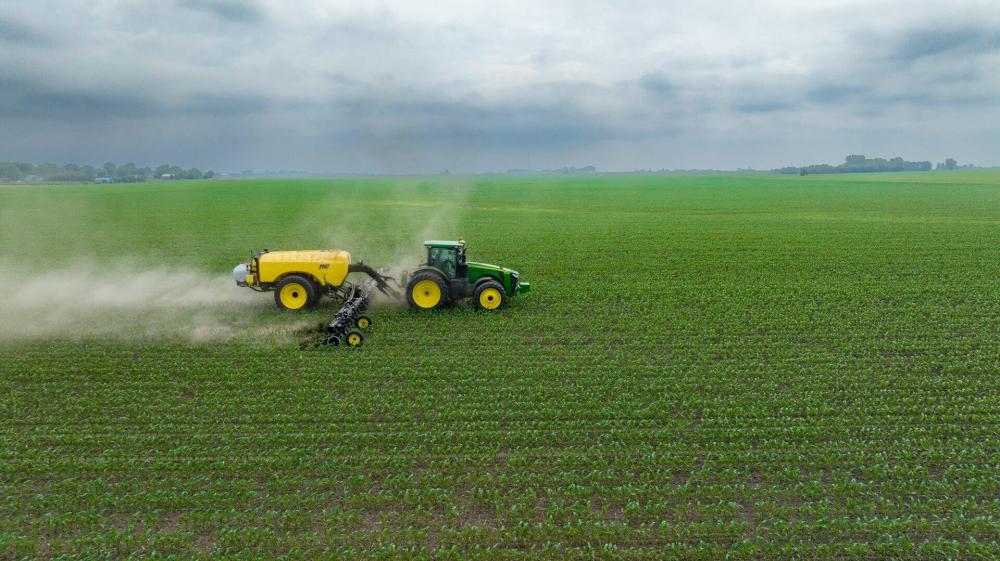
Compound fertilizers represent a qualitative leap in the history of agriculture, as they have transformed from mere soil supplements into precise and intelligent tools that enable farmers to make the most of every drop of water and every inch of land. In this comprehensive article, we take you on an applied educational journey to understand the world of compound fertilizers in all its dimensions, from its scientific definition and the various types of compound fertilizers, to its pivotal role in improving productivity and crop quality, to the smart criteria for choosing the appropriate fertilizer for each crop and agricultural conditions, and how to access these vital products through Al-Talib Store.
The importance of fertilizers in improving plant growth and crop quality
Fertilizers play a pivotal role in bridging the global food gap and ensuring the production of high-quality crops. The following is the importance of all types of compound fertilizers in improving growth and productivity:
- Soil often acts as a limited storehouse of nutrients, especially with intensive farming. Fertilizers offer a direct solution to this problem by supplying plants with elements that are lacking or not available in sufficient quantities in the soil.
- Compound fertilizers are designed to meet the precise nutritional needs of specific crops at different stages of growth, such as vegetative growth, flowering, and fruiting.
- Enhancing vegetative growth and productivity: Nitrogen (N) is the most prominent element, acting as a key driver of growth, chlorophyll formation, increasing leaf area, and raising the quantitative productivity of field crops.
- Improving the quality of fruits and crops, as nutrients directly affect the specifications of the final product. Phosphorus (P) improves root development, fruit ripening, and accelerates crop ripening.
- Potassium (K) plays a key role in the transport of sugars and starches within the plant, increasing the sweetness of the fruit, improving color and aroma, increasing the soluble solids content in the fruit, and enhancing the thickness of the skins in some crops, thus extending their storage period and reducing losses.
- Well-nourished plants become stronger and more resistant to diseases and pests, and some elements (such as potassium) promote the thickening of cell walls.
- Compound fertilizers allow for the correction of soil problems, nutritional imbalances, and deficiencies in specific elements that manifest symptoms in plants such as yellowing of leaves and weak flowering.
The difference between compound fertilizers and organic fertilizers
Understanding the key differences between compound fertilizers and organic fertilizers is crucial for any farmer or anyone interested in agriculture. Below is a detailed comparison showing the main differences:
Chemical composition
- Compound fertilizers: These are pure or semi-pure chemical compounds such as urea (nitrogen), superphosphate (phosphorus), or potassium chloride (potassium). The ratio is clearly written on the package (e.g., NPK 20-20-20).
- Organic fertilizers: A heterogeneous mixture of decomposed materials, whether animal manure, compost, or green manure, containing nutrients in a complex form bound to the organic matter.
Working mechanism and timing
- Compound agricultural fertilizers: Like a quick meal for plants, they provide a rapid burst of nutrients and are ideal for correcting severe deficiencies or supporting growth at critical stages.
- Organic agricultural fertilizers: Like a slow-digesting complete meal, they release elements gradually as the organic matter decomposes, ensuring continuous nutrition and reducing nutrient loss through leaching.
Overall impact on the agricultural system
- Compound fertilizers: They focus on the plant only and their main goal is to increase crop productivity in the current season.
- The best types of organic fertilizers: They focus on the entire ecosystem (soil-plant), improve the permanent fertility of the soil, and increase the diversity of beneficial organisms (bacteria, fungi, earthworms), creating a more resilient and healthy agricultural environment.
Potential risks
- Compound fertilizers: risk of chemical burns to the plant if the dose is increased, risk of groundwater contamination with nitrates and phosphates, and soil stress with repeated use without the addition of organic matter.
- Organic fertilizers: risk of transmitting pathogens if not properly prepared (composted), may attract insects or rodents, and may be nutritionally unbalanced if based on a single source.
You may be interested in: Types of agricultural soil conditioners
What are compound fertilizers?
Compound fertilizers are synthetic fertilizers that contain two or more major nutrients in a single chemical compound. They are manufactured through chemical processes to combine the elements into stable molecular formulas and consist of the three essential macronutrients, symbolized by NPK:
- Nitrogen (N) is needed for vegetative growth and leaves.
- Phosphorus (P) is needed for root development and flowering.
- Potassium (K) for fruit quality and stress resistance.
- Sometimes minor and trace elements such as calcium (Ca), magnesium (Mg), sulfur (S), iron (Fe), zinc (Zn), copper (Cu), and manganese (Mn) are added to it.
Types of compound fertilizers
The variety of compound fertilizers is a strength and an opportunity for the smart farmer. Here are the types of compound fertilizers:
- Binary fertilizers contain two main elements of (NPK), whether it is nitrogen + phosphorus, nitrogen + potassium, or phosphorus + potassium.
- Triple fertilizers are the most commonly used and contain the three main elements and are balanced, such as 20-20-20, 15-15-15, or high nitrogen 30-10-10 for vegetative growth, or high phosphorus 10-30-20 for roots and flowering, or high potassium 10-10-30 for fruits and ripening.
- Multi-nutrient fertilizers containing NPK + minor and micronutrients such as NPK + magnesium + sulfur, or NPK + calcium + boron, or NPK + complete micronutrients.
- Nitrate fertilizers are fast-dissolving and absorbing, such as calcium nitrate (Ca(NO₃)₂).
- Ammonium fertilizers are transformed in the soil before absorption, such as ammonium sulfate ((NH₄)₂SO₄).
- Urea fertilizers have the highest concentration of nitrogen (46%) and are converted into ammonium in the soil.
- Phosphate fertilizers such as single superphosphate, triple superphosphate and ammonium phosphate.
ﻻ
The role of agricultural fertilizers in improving production
All types of compound fertilizers are the backbone of modern intensive agriculture, contributing up to 50-60% to the increase in global crop productivity, improving crop quality and the chemical composition of fruits. Nitrogen increases proteins in grains, while potassium increases starches and sugars, improves the oil content in oilseeds, and improves marketing specifications in terms of fruit size, color, and firmness, thus increasing storage period.
You might be interested in: Which is better, organic or chemical fertilizer?
How to choose the right fertilizer for the type of crop
Choosing the right fertilizer is both a science and an art, and it depends on an integrated understanding of several interrelated factors, the most important of which is knowing the crop's nutritional needs. Soil analysis is the scientific basis for determining the level of available elements, pH, organic matter, and soil salinity, in addition to determining the growth stage, whether it is the preparation and planting stage, the vegetative growth stage, the beginning of flowering, fruit formation, or fruit ripening.
Al-Talib Store for all types of compound fertilizers
Al Taleb Store is your comprehensive destination for the best compound agricultural fertilizers. We are a success partner to more than 5,000 farmers. We believe that healthy soil is the foundation of successful agriculture, and we offer you integrated solutions to achieve this, with a wide range of the best types of compound fertilizers, whether high-quality dual or specialized triple (NPK) fertilizers, crop fertilizers, and the best types of organic fertilizers.
conclusion
Compound fertilizers are no longer just an ordinary agricultural input, but have become a specialized science and a strategic necessity in the world of modern agriculture. In this article, we have reviewed the complete journey of the best types of compound fertilizers, from their precise chemical composition and all types of compound fertilizers to meet the needs of different crops, to their crucial role in bridging the global food gap by increasing productivity and improving quality. You can contact Al-Talib Store to obtain all compound fertilizers through the WhatsApp social networking site.
Frequently asked questions about types of chemical fertilizers
What is the difference between compound and mixed fertilizers?
Compound fertilizers contain chemically combined elements in the same molecule, while mixed fertilizers are simply a mechanical mixing of simple fertilizers.
How often should compound fertilizers be added?
It depends on the type of crop, the stage of growth and the type of fertilizer, but generally it is added at planting and as supplementary stages during the growing season.
Can compound fertilizers be mixed together?
Caution must be exercised when mixing fertilizers, as some are incompatible and may lose their effectiveness or form harmful compounds.
How do I store compound fertilizers?
Compound fertilizers can be stored in dry, cool places, protected from moisture, and in their original packaging, away from the reach of children and animals.
What are the signs of excessive use of compound fertilizers?
Burning of leaf tips, stunted growth, accumulation of salts on the soil surface, and groundwater pollution.
Do compound fertilizers harm the soil in the long run?
When used in a balanced and thoughtful manner, it does not harm the soil, but excessive use without adding organic matter may lead to a deterioration of soil properties.