
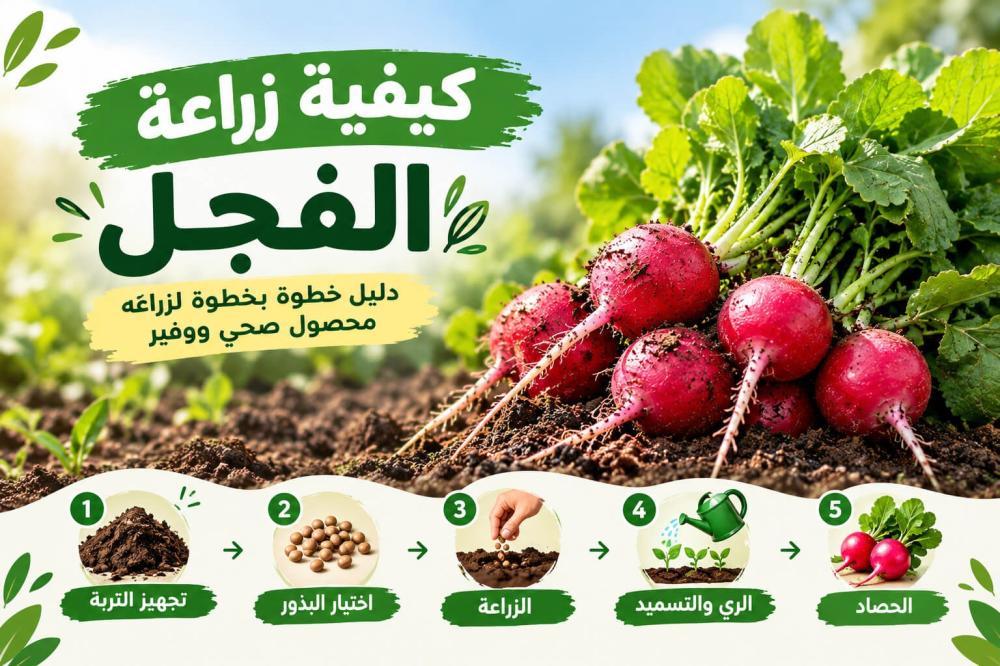
How to grow radishes? Radish cultivation involves four basic steps: (1) Prepare light, well-draining soil; (2) Sow the seeds 1 cm deep, spacing them 5-10 cm apart; (3) Water regularly to maintain consistent moisture without overwatering; (4) Harvest after 25-45 days, depending on the variety and climatic conditions. This article will guide you through the details of radish cultivation.
Why is radish the perfect choice for your farm?
Radishes are among the fastest-growing and most profitable root crops for farmers, as they can be harvested within a short period of 25 to 45 days from planting. They are easy to cultivate and can be grown year-round, although crop quality varies depending on the season.
Basic steps for growing radishes in brief points:
- Soil preparation: Light, well-drained soil with decomposed manure.
- Sowing: 1 cm deep with 5-10 cm spacing between plants
- Irrigation: Regular irrigation without overwatering or underwatering
- Harvesting: After 25-45 days depending on the variety
At Al Talib Agricultural Store, we have over 35 years of experience in providing the best seeds, fertilizers and agricultural solutions to farmers in Saudi Arabia and the Arab region.
Shop for the best agricultural seeds at Al Talib Store
Radish cultivation requirements: environment, climate, and soil
Suitable climate: Does the radish need direct sunlight or can it grow in the shade?
Radishes need at least 6 hours of direct sunlight daily to develop strong, plump roots. The ideal temperature for growth is between 16-18°C, while germination occurs optimally between 18-29°C.
Impact of harsh climatic conditions:
To protect your crop from the summer heat, we recommend using high-quality agricultural shade nets available at Al-Talib store, manufactured from UV-treated materials to ensure effective protection for your crops.
Does radish need heavy clay soil or sandy soil?
The ideal soil for radishes is light to medium-textured, well-drained and aerated. Here is a comparison of soil types:
- Light sandy soils: characterized by excellent drainage and straight roots, but one of their disadvantages is rapid drying out and they require frequent watering.
- Heavy clay soil: characterized by moisture retention but it distorts roots and has poor drainage
- Medium yellow: This is the best for radishes as it has a perfect balance, but it needs good preparation.
For home gardening in pots and balconies, Al Taleb store provides ready-made mixtures of peat moss and perlite in ideal proportions that ensure good ventilation and excellent drainage for the roots.
Radish planting time: schedule according to region and growing season
When is radish planted in Saudi Arabia, Egypt, and Jordan?
The ideal period for growing radishes in the Arab region is from September to February, when the weather conditions are mild and the days are short.
- Saudi Arabia: October - January
- Egypt: September - November (Lower Egypt), planting in December is possible in Upper Egypt
- Jordan: September - February
Varieties and differences between varieties
The difference between red and white radishes:
- White radish (Chinese/Japanese): Long roots, less pungent taste, matures in 45-60 days
- Round red radish: matures faster (25-40 days), suitable for home gardening
- Black radish: less common, stronger flavor, longer growing period
Is it successful to grow radishes in the summer?
Foreign varieties do not thrive in high temperatures, leading to premature flowering and the formation of empty, poor-quality roots. Local varieties are more tolerant and can be planted in summer, but harvesting should be done early, before the plants begin to flower.
How to grow radishes at home and in large spaces
Stages of growing radishes at home (pots and balconies)
Tools required to get started immediately:
- Pots at least 20-25 cm deep
- Ready-made agricultural mix (peat moss + perlite)
- High-quality radish seeds
- light water spray
Steps for home gardening:
- Fill the pots with the prepared mix, leaving 2 cm from the rim.
- Plant the seeds at a depth of 1 cm with a distance of 5 cm between the seeds.
- Cover the seeds with a thin layer of soil and press down gently.
- Water gently until the soil is moist but not waterlogged.
- Place the pots in a sunny spot for 6 hours daily.
Get ready-made peat moss and perlite mixes from Al Talib Store for a perfect start to your home farm.
How to grow radishes in large areas (for commercial farms)
Land preparation:
- Plow the land two to three times with good smoothing.
- Add 20-30 cubic meters of decomposed organic manure per acre
- Leveling and planning the land at a rate of 12 lines per two qasabas
Quantity of seeds required per acre:
- Foreign varieties: 4-5 kg/acre
- Local varieties: 8-10 kg/acre
Growing radishes by drip irrigation versus flooding:
- Drip irrigation: Saves 40-50% water, provides more precise irrigation control, and reduces the spread of diseases.
- Flooding: Lower costs initially, but higher water consumption and risk of root rot.
Al-Talib experts' advice: Use certified radish seeds from reliable sources to ensure a high germination rate and a uniform crop.
Shop for the best agricultural and chemical pesticides at Al Talib Store
Post-planting service operations: irrigation, fertilization, and thinning
How often should radishes be watered per week?
Regular watering is key to successful radish cultivation. Consistent moisture prevents root cracking and ensures even growth. Here is the recommended watering schedule:
- Winter: Every 5-7 days | Depending on soil type
- Summer: Every 3-4 days | Monitor for dehydration
- Germination: Daily (lightly) until seedlings appear
Warning: Avoid cycles of drought followed by flooding, which cause root cracking and an increase in the hot (pungent) substance.
What is the appropriate fertilizer for radish root growth?
The danger of excessive nitrogen: It leads to massive leaf growth at the expense of root formation, resulting in a headless, grassy crop.
Recommended fertilization program per acre:
- The first application before planting: 100 kg ammonium nitrate + 50 kg superphosphate
- The second batch, after 20 days, consists of 50 kg of ammonium nitrate + 50 kg of potassium sulfate.
Phosphorus and potassium are essential for the formation of large, high-quality roots. We recommend using balanced fertilizers free of excess nitrogen, available at Al-Talib Store.
Weeding and thinning out overcrowded plants
- Surface hoeing 15 days after planting to get rid of weeds and close cracks
- Thinning is done when plants reach a height of 5 cm, leaving a distance of 5-10 cm between plants.
Physiological problems in radish cultivation and how to solve them
Why do the leaves grow so densely in radishes and the head doesn't form?
- The main reason: excessive nitrogen fertilization.
- Solution: Reduce nitrogen and increase phosphorus and potassium. Specialized root-forming fertilizers are available at Al-Talib Store.
What causes radish roots to crack, and why does it taste so spicy?
- Cracking: due to fluctuating irrigation (thirst then flooding)
- Excessive heat due to heat stress and lack of water
- woody roots due to delayed harvest
Causes of early flowering and emergence of flower spikes
- High temperatures (above 25°C) stimulate early flowering
- Long days affect foreign varieties
- Water stress accelerates flowering
Solution: Plant at the appropriate times, choose resistant varieties, and harvest early when necessary.
Radish pests and diseases and methods of control
Fungal diseases: downy mildew and root rot
White Rust: It appears as white pustules on the leaves, caused by the fungus Albugo candida.
Combating:
- Remove and burn the remains of the infected crop
- Spraying with recommended pesticides
- Improving ventilation between plants
Root rot: caused by overwatering or poor drainage.
Use safe pesticides recommended by the Ministry of Agriculture and available at Al-Talib Store to ensure effective control while maintaining crop safety.
Protecting seedlings from birds and rodents
The protective netting from Al-Wissam Factory, part of the Al-Talib Group, provides an ideal solution for protecting young seedlings from birds and rodents while allowing light and air to pass through.
You might be interested in: The best agricultural pesticides from Al-Talib Store
Signs of radish ripeness and harvesting
How many days does radish need to grow until harvest time?
- Early foreign varieties: 25-35 days
- Medium varieties: 35-45 days
- Local varieties: 45-60 days
How do I know when my radish crop is ripe?
Here are the signs of maturity:
- Protrusion of the upper part of the root above the soil surface
- Root reaching the appropriate size for the variety
- The peel's shine and straightness
- Harvesting in the early morning to preserve the freshness of the roots
Warning: Delaying harvesting leads to root fibrosis, increased heat and woodiness.
Expected crop yield per acre
- Local varieties: 10-12 tons/acre
- Foreign varieties: 7-8 tons/acre
Conclusion
Now that you know how to grow radishes in detail, from preparing the soil and choosing the right time, to irrigation, fertilization, and pest control, it's time to turn your knowledge into a bountiful harvest. Al-Talib Agricultural Company has been your trusted partner since 1987 in providing:
- High-quality radish seeds from the best global sources
- Specialized fertilizers rich in phosphorus and potassium for optimal root development
- Shading and protection netting from our factories to withstand harsh weather conditions
- Safe and effective pesticides for pest control
- Free agricultural consultations from our expert team
Frequently asked questions about growing radish seeds
How long does it take for radish seeds to germinate after being placed in the soil?
Radish seeds germinate in 3-4 days at a temperature of 18-29°C. Germination speed decreases if the temperature drops below 13°C.
Can radishes be replanted from cut heads?
No, radishes cannot be replanted from cut heads. Radishes are root crops grown directly from seed in permanent soil; they do not propagate from heads.
What is the ideal temperature for radish seeds to germinate?
The ideal temperature for germination is 18-29°C. For optimal growth, it is 16-18°C.
What should be planted alongside radishes to improve their growth?
Good companion planting with radishes:
- Lettuce and spinach: they fill the gaps between the rows
- Carrots: Roots at different depths that do not compete
- Mint: repels harmful insects
Avoid planting radishes next to other cruciferous crops (cabbage, cauliflower) to avoid the transmission of common diseases.