
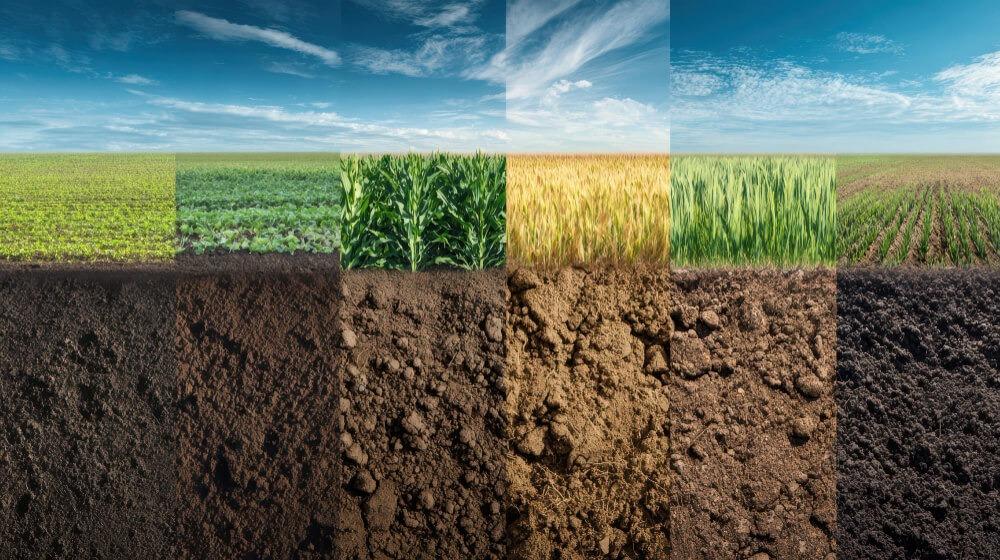
Understanding the difference between sandy and clay soils is the first and most important step toward achieving a bountiful and healthy harvest. Whether you're a professional farmer or a home gardening enthusiast, knowing the characteristics of each type will transform how you work with your land. In this comprehensive guide from Al Talib Store, we'll take you on a detailed journey to understand everything you need to know about sandy and clay soils, from their definition and properties to methods for improving them, with examples of suitable crops for each in Saudi Arabia.
What is sandy soil?
It is a lightweight soil composed primarily of large particles of rock fragments and minerals, most notably quartz and mica. This soil is characterized by its coarse grains, which, under a microscope, resemble sugar granules. It is also known as a "starved soil" because it does not retain water or nutrients for extended periods.
Origin of sandy soil formation
Sandy soils are formed as a result of the mechanical weathering of rocks, especially granite. When these rocks are exposed to erosion from wind and rain, they break down into small particles that retain their angular or rounded shape.
color of sandy soil
One of the most distinctive features of sandy soil is its light color, ranging from pale yellow to sandy and light gray. This color is due to a high quartz content and a low organic matter content. In some areas, red sandy soil may be found due to the presence of iron oxides.
Distinctive characteristics of sandy soil
- Superior water drainage: dries quickly after watering or rain.
- Excellent ventilation: Plant roots breathe easily.
- Poor nutrient retention: Fertilizers are washed away quickly.
- Its temperature rises rapidly: it is known as warm soil in which bacteria become active early in the spring.
What is clay soil?
It is a heavy, cohesive soil made up of very fine particles invisible to the naked eye (less than 0.002 mm). These particles resemble stacked sheets that trap water and nutrients between them, making it a rich but stubborn soil.
Clay soil composition
Clay soils are produced from the chemical weathering of rocks such as feldspar. Due to the small size of their grains, the pores between them are almost nonexistent, which impedes the movement of water and air.
Clay soil color
It is characterized by dark colors ranging from reddish-brown (rich in iron oxide), dark gray, and sometimes black when it is rich in organic matter.
Main properties of clay soil
- Exceptional water retention: It may remain wet for weeks after watering.
- High natural fertility: rich in minerals and micronutrients.
- Poor ventilation: The roots suffer from a lack of oxygen.
- Firmness and flexibility: It can be molded like clay when wet, and cracks severely when dry.
The difference between sandy and clay soils
The difference between sandy and clay soils can be summarized in 7 key points:
- The particle size of sandy soil is large (0.05 - 2.0 mm), while clay soil is very small (less than 0.002 mm).
- The texture of sandy soil is coarse, dry, and crumbles easily, while clay soil is soft, smooth (fine-grained), and sticky when wet.
- Water retention in sandy soil is very poor (it is like a sieve), while clay soil is excellent as it is like a sponge.
- Aeration (oxygen) is excellent for sandy soil, while clay soil has weak to non-existent aeration.
- Fertilizer retention in sandy soil is poor (rapid leaching), while clay soil is excellent as it stores elements.
- The rate of heating in sandy soil is rapid (early warming soil), while clay soil is slow and cold, taking time.
Characteristics of sandy soil in detail
Characteristics of sandy soil in detail
The advantages that make sandy soil ideal for agriculture in some cases:
- Compression resistance: It does not clump together, allowing roots to penetrate freely.
- Easy leaching: It can be used to easily flush out excess salts, which is beneficial in areas with high salinity.
- Early planting: Because it dries and warms up quickly, it can be planted before clay soil in the spring.
The drawbacks that make sandy soil a challenge for farmers
- Nutritional deficiencies: Naturally lacking in potassium and magnesium.
- Acidity (pH): Often slightly acidic due to the washing away of bases (calcium and magnesium).
- Rapid nighttime cooling: It loses heat quickly at night, which can harm heat-loving plants.
How do you deal with sandy soil for agriculture?
- To obtain productive sandy soil for agriculture, the following must be added:
- Organic materials (compost, peat moss): to increase their ability to retain water and nutrients.
- Decomposed organic manure: to add macronutrients.
- Drip irrigation: Frequent irrigation in small amounts is better than infrequent heavy irrigation.
Properties of clay soil in detail
The characteristics of strong clay soil are detailed below.
The advantages that make farmers desire it in terms of fertility
- A natural food storehouse: It contains minerals such as iron, zinc, and calcium.
- Drought resistance: It retains its moisture for many days, reducing the number of times it needs to be watered.
- High cation exchange capacity (CEC): It can hold thousands of positive ions like a fertilizer.
The flaws that turn it into an agricultural nightmare if not managed properly
- Clumping: When dry, it becomes as hard as cement, difficult to penetrate with an axe or plow.
- Drowning: When wet, it becomes sticky and prevents water from seeping through, causing root rot.
- Deep cracks: In the summer, large cracks appear, reaching a depth of one meter, tearing the roots of the trees.
Optimal handling of clay soil
To improve clay soil:
- Adding agricultural gypsum (calcium sulfate): helps in breaking up clay clumps (agglomeration).
- Add coarse sand (but with extreme caution): Incorrect addition may turn the soil into concrete.
- Adding organic matter in large quantities: Compost improves aeration and breaks down clumps.
How do you determine your soil type yourself?
Before you buy anything from Al Talib store, try these simple tests:
First test: The touch test (Ball Test)
- Take a handful of moist soil (not dry and not clayey).
- Squeeze it in the palm of your hand, then open it.
If it crumbles immediately, it is sandy soil. If it forms a cohesive ball that does not break easily, it is clay soil. If it forms a ball but breaks with a slight push, it is loam soil, which is the best.
Second test: The Jar Test (pigeon test)
- Place a quantity of soil in a clear glass jar (half a jar).
- Fill it with water to two-thirds full.
- Add a teaspoon of table salt (to speed up soil disintegration).
- Close the jar and shake it vigorously for two minutes.
- Leave it to rest for 24 hours.
- Bottom layer: Sand (settles first).
- Middle layer: clay.
- Top layer: Clay may remain stuck in the water for days.
Third test: The Sausage Test (Ribbon Test)
Moisten a soil sample and try to form thin sausages between your thumb and forefinger:
- Sandy soil: It doesn't form sausages, it collapses.
- Clay soil: forms long, soft sausages that are more than 5 cm long.
Crops suitable for sandy soil in Saudi Arabia
Due to its rapid drying and high warmth, sandy soil is ideal for crops that dislike wet feet. In Saudi Arabia, sandy soil is used for agriculture for the following purposes:
root vegetables
- Carrots: They grow long and straight in loose soil.
- Potatoes: produce clean, undamaged tubers.
- Radishes and beets: They like light soil.
legumes
- Peanuts: They need soft, sandy soil to enable the pods to grow below the surface.
- Beans and peas: perform well.
Herbs and leafy vegetables with regular watering
- Lettuce, arugula, parsley: but with the addition of organic fertilizer and daily watering.
Fruit trees with improved soil
- Citrus fruits (oranges, lemons) if clay or organic matter is added to retain water.
- Olives adapt perfectly to well-drained sandy soil.
Crops suitable for clay soil in the Kingdom
Clay soil, with its strong water retention and high fertility, is home to crops that are heavy consumers of water and nutrients:
large grains
- Wheat: grows vigorously in heavy clay soil.
- Barley and sorghum (white corn).
Stone fruit
- Palm trees (date palms): Date palms like deep clay soil that retains moisture.
- Mangoes, apricots, and peaches thrive in this soil.
heavy vegetables
- Cabbage, cauliflower, and broccoli: need rich soil.
- Zucchini and eggplant: give abundant production in clay soil.
fodder
- Alfalfa (Alfalfa): Loves deep roots in firm soil.
Methods for improving sandy soil and increasing its fertility
Methods for improving sandy soil and increasing its fertility; here's a solution from Al-Talib Store:
Solution 1: Organic growth (your secret weapon)
- Add between 20-30% of the soil volume as organic matter:
- Peat moss: retains water equivalent to 20 times its weight.
- Mature manure: adds food and helps in the formation of humus.
- Homemade compost: the least expensive.
The second solution: using absorbent polymers
These tiny granules absorb 400 times their weight in water and slowly release it to the roots. Ideal for sandy soils.
Third solution: Frequent irrigation technique
Instead of one heavy watering that washes away the fertilizer, divide the watering into 3-4 times a day in small amounts (10 minutes each time).
Fourth solution: Planting cover crops (green manure)
Sow alfalfa or vetch out of season, then work it into the soil while it's still green. It will decompose and turn into humus, improving the soil.
You might be interested in: Shop for the best agricultural seeds from Al Talib Store
Methods for improving clay soil and breaking up its clumps
Clay soil needs loosening, not fertilization. Here are ways to improve clay soil and break up its clumps:
First solution: Agricultural gypsum (a magic solution)
Add agricultural gypsum (calcium sulfate) at a rate of 2-5 kg per 10 square meters. The calcium replaces sodium ions and binds clay particles into larger granules (agglomerates).
Solution 2: Never use coarse sand alone
Common mistake: Adding sand to clay produces bricks! Instead, add organic fertilizer at a huge rate (5-10 cm thick layer).
Third solution: Farming on raised beds (elevated beds)
Raise the soil level 20-30 cm above the ground level on a raised platform. This allows excess water to drain and the soil to heat up faster.
Solution 4: Earthworms and root fungi
The worms crawl through the mud and create ventilation tunnels. Buy red worm eggs and add them to the soil.
Al-Talib Agricultural Store for all types of soil
At Al Talib Store , the best online agricultural supplies store , we understand that every farm is unique, and that choosing the right soil is half the battle. Therefore, we have provided you with:
- Sandy soil for planting, sterilized, free of pollutants and pre-mixed with ideal proportions of organic fertilizer.
- High-quality pure clay soil, purified of stones and enriched with agricultural gypsum to be ready for immediate use.
- Organic and chemical fertilizers specifically designed to compensate for the deficiencies of each soil type.
- Soil improvers such as polymers, agricultural gypsum and biohumus are game-changers.
- Agricultural consultations through our specialized team to help you accurately determine your land's needs.
Whether you are suffering from fertilizer washing into your sandy soil or from cracking and clumping of clay soil, we have the solution.
Conclusion
The difference between sandy and clay soils lies in the very nature of agriculture. While sandy soils are known for their looseness and ease of cultivation, they require constant support with water and fertilizer. Clay soils, on the other hand, offer a vast reservoir of nutrients and water, but demand extra effort to loosen and aerate them. No single soil type is absolutely perfect, but there is one that is managed correctly. By adding organic matter, selecting the right crops, and consulting reliable sources like Al-Talib Store, you can transform any soil into a lush, fertile paradise. Don't hesitate to visit our website to find the perfect soil for your crops.
Frequently Asked Questions
Can sandy soil be mixed with clay soil to create ideal soil?
Theoretically, yes. The best soil is loam, which is a mixture of sand (40%), silt (40%), and clay (20%). However, in practice, if you have heavy clay soil, don't add sand alone without substantial amounts of organic matter, otherwise the soil will become as hard as cement.
What plants are suitable for both sandy and clay soils?
Figs and pomegranates. These two plants are drought-tolerant (suitable for sandy soils) and water-tolerant (suitable for clay soils). However, they generally perform best in medium loamy soils.
Why are the roots of my plants rotting in the clay soil even though I reduce watering?
Because clay soil traps water in its fine pores and doesn't allow oxygen to pass through, the roots suffocate (due to lack of oxygen) before they die of thirst. Solution: Add coarse organic matter (rice husks, sawdust) and raise the raised beds.